
Invisible to us Isaac
Information
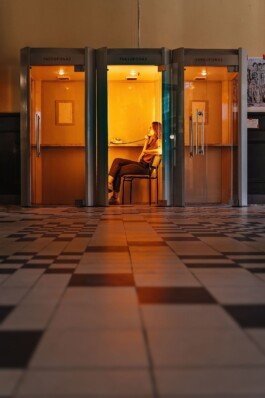
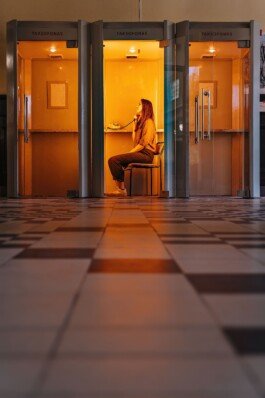
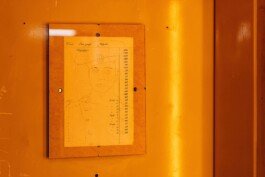
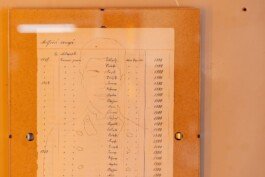
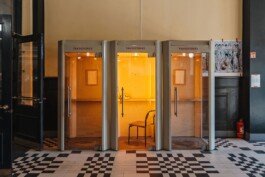
2023, Mixed media installation: Three vintage Soviet telephone booths with yellow light, a customized Soviet telephone set playing a 47-second audio loop, two pencil portraits on pages from a 1922 Greek accounting book found in Istanbul (23 × 34 сm) each, a fragment from the film Mimino HD, 3’39’’ with Lithuanian subtitles and special color grading, a Soviet telephone receiver suspended on the wall.
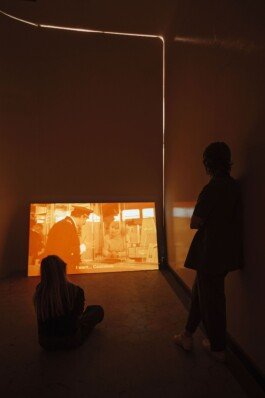
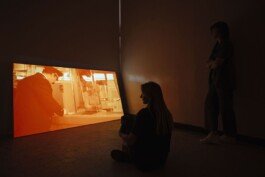
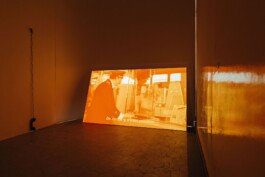
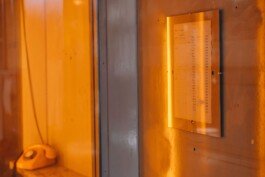
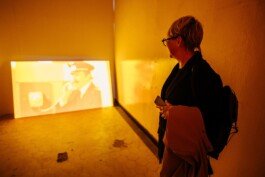
Nikolay Karabinovych made good use of the phone booths of the ground floor next to the entrance – through the VEF telephones handset Georgian singing can be heard. This is an audio-quote from the movie Mimino, while the video-quote can be seen in one of the rooms on the first floor – the scene being projected there is of the main character trying to call the small Georgian village Telavi, but gets connected to Tel-Aviv. On the other end, a Georgian immigrant picks up the phone, so contact ends up established despite all communication breakdowns, – two people sing the same song together, the one we can hear in the phone booths on the first floor.
As part of the Kaunas Biennial, Nikolay Karabinovych presents the multi-layered installation “Invisible to Us Isaac,” which deftly interweaves Soviet film history, the divided fates of the Zdanevich brothers, and the cultural memory of the post-Soviet space.
Located in a former post office building, the work activates defunct telephone booths, transforming them into portals that reconnect interrupted dialogues across historical ruptures.
The installation is spread across two floors. On the ground level, inside former booths once used for international and long-distance calls, the artist reconstructs a key episode from the cult Soviet film Mimino (1977, dir. Georgiy Daneliya). In this scene, the protagonist, Georgian pilot Valiko Mizandari, attempts to call his hometown of Telavi, but due to an operator’s error is connected instead to Tel Aviv. In the absurd and tender exchange between two accidentally connected Georgians—one in the USSR, the other in Israel—a fleeting sense of intimacy emerges, as Isaac (the voice on the other end) begins to sing the Georgian lullaby “Iavnana.”
This lullaby, performed by an Isaac who remains invisible to us, becomes the emotional core of the work—a poignant symbol of cultural memory displaced across borders and constraints. In traditional Georgian folklore, “Iavnana” is a mother’s song to her child, a healing melody sung to ward off illness.
In Karabinovych’s installation, the lullaby is heard when the viewer lifts the receiver of an old telephone.
In two additional booths, the artist presents pencil portraits of the Zdanevich brothers—Ilia and Kirill—avant-garde artists whose lives were split by the Iron Curtain. Ilia (Ilyazd) emigrated to France after the revolution, becoming part of the Parisian avant-garde and collaborating with figures such as Coco Chanel, Picasso, and Giacometti, while his brother Kirill remained in the Soviet Union, where his experimental work was marginalized by official cultural policy for decades. Geography separated them for years, turning their artistic dialogue into a series of unspoken monologues.
On the second floor, the viewer encounters a screen showing the lullaby scene from Mimino, alongside a telephone receiver protruding from the wall—an object that is at once an artifact of the past and a symbol of failed connection.
Within the post-Soviet condition, the work becomes an act of decolonizing memory, restoring voices and histories that have been marginalized within official narratives.
The title “Invisible to Us Isaac” points to unseen connections and lost contacts: Isaac, singing from another world, becomes a metaphor for invisible communities and voices pushed to the periphery of cultural memory. Through this work, the artist invites the viewer to reflect on the many forms of “invisibility”—historical, cultural, and personal—that shape our perception of both past and present.
By using the space of a former post office—a site originally intended for communication—Karabinovych creates a poetic meditation on broken connections, diasporic identities, and nostalgia as a political affect, one that remains acutely relevant in the context of ongoing global divisions and new forms of alienation.


Exhibitions
2023 Kaunas Biennale