Information
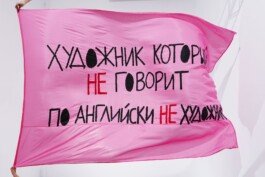
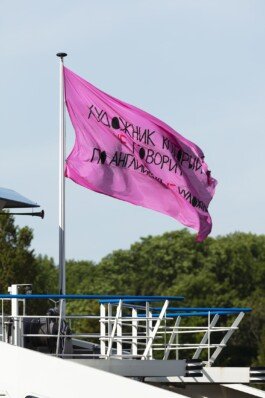
2016, 120 × 350 cm
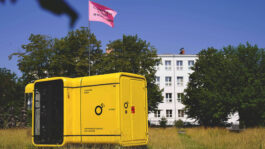
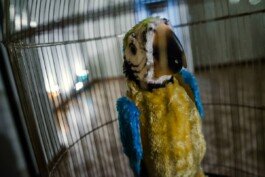
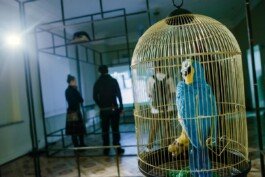
2016, Mixed media installation: Dimensions variable, Cage, toy parrot, portable speaker, audio loop 4’13’’
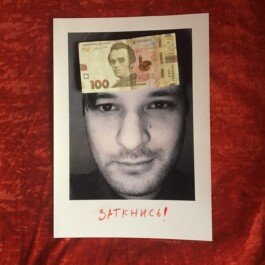
2015, Заткнись! (Shut Up) Color photograph, marker, 100-hryvnia banknote 21 × 29.7 cm
With sharp irony, Karabinovych treats failure as part of the creativity process, turning mistakes into opportunities for experimentation. His works are sort of homages and translations, tracing artistic influences across places and time: from Odessa Conceptualism in 80s, to Balkan’s Mladen Stilinović and IRWIN. From Marcel Broodthaers in 70s to Moscow Actionism in 90s.
By reworking iconic works - such as Stilinović’s “An Artist Who Cannot Speak English is No Artist” or his “Sing!” — Karabinovych shifts it meaning into today’s political and linguistic conditions. A hryvnia note across the forehead says not “sing” but “shut up,” asking whether art can still speak freely under pressure. A toy bird replaces Broodthaers’s parrot, probing authenticity and representation.


The title “As far I’m young I make bad works” speaks with disarming honesty. It sounds like a confession, but also a clever strategy: by admitting failure upfront, the artist turns weakness into strength. This gesture captures the insecurity and doubt that often accompany the early stages of artistic life. At the same time, it suggests that mistakes, flaws, and “bad works” are not something to hide but part of the creative process itself. The phrase protects the artist from outside judgment and invites viewers to reflect on how value is formed in art.
The self-irony embedded in this formulation reveals deeper anxieties about artistic legitimacy, particularly for artists working from peripheral positions within global art networks. By claiming the production of "bad works," Karabinovich exposes the violence of aesthetic judgment while creating space for experimentation beyond the crushing weight of institutional expectation. This gesture recalls the strategic naivety employed by various avant-garde movements, yet it operates within a post-conceptual framework that recognizes the impossibility of genuine innocence in contemporary practice.
The works from this series function as homages, a sort of archaeological excavations of influence that map the artist's intellectual and aesthetic genealogy. These works act as gestures of recognition, linking places and times together. They also are acts of translation, carrying ideas across linguistic and cultural barriers while necessarily transforming them through the process of transmission.
Karabinovich’s practice grows out of Odesssa Conceptualism, the unique artistic movement that shaped a distinct voice within Soviet art. Known for its irony, wordplay, and sharp critique of reality, the Odesssa scene forms an important reference point for his work. What makes this series stand out, however, is how it moves beyond Ukraine’s artistic context, extending toward the Balkans with their own traditions of institutional critique and experiments with language. By referencing Croatian and Slovenian practices — like the OHO group, Mladen Stilinović, and IRWIN — Karabinovych expands the frame of Ukrainian contemporary art. This southward turn away from the dominant Western European and American models creates new possibilities for artistic dialogue and mutual recognition among artists working from similarly peripheral positions within global art circuits.
Stilinović's banner work "An Artist Who Cannot Speak English Is No Artist" stands as one of the most incisive critiques of linguistic hegemony in contemporary art. The work's directness — words sewn onto a banner with clinical precision — belies its complex meditation on access, exclusion, and the conditions of artistic legitimacy under globalization. Stilinović's statement operates simultaneously as protest, resignation, and strategic accommodation, acknowledging the practical necessity of English competence while highlighting the cultural violence this requirement perpetuates.
Karabinovich's remix of this work introduces a crucial shift: the text rendered in Cyrillic script and Russian language immediately complicates Stilinović's proposition. Where Stilinović's banner performed its critique while remaining accessible to the English-speaking global art world it critiqued, Karabinovich's version enacts a form of linguistic resistance that makes the work partially illegible to that same audience. The question becomes: if an artist writes this statement in their native language rather than English, are they still an artist according to the logic the work itself articulates? After seeing Stilinović’s banner we recognize the reference, but the non-English script produces a paradox: we hesitate, unsure whether the author of this statement is truly an artist according to the logic of the original work. The act of recognition collides with the act of estrangement, opening a gap between legibility and belonging.”

In Mladen Stilinović’s PJEVAJ! (1980), the artist ironically aligned himself with the figure of the street musician: a banknote glued to the forehead evoked the ambivalent position of the artist in society — tolerated yet marginalized, necessary yet undervalued. Money was not only payment, but also a sign of power, determining who had to “sing” in order to survive.
Nikolay Karabinovych’s work directly quotes Stilinović but introduces a radical shift: instead of the imperative “Sing!”, the inscription reads “Shut up!”. This inversion transforms the banknote from a symbol of forced performance into an instrument of silencing. The 100-ukrainian hryvnia note across the forehead embodies censorship rather than support, economic pressure rather than recognition. Karabinovych questions whether art, under conditions of political and economic turbulence, can still act as a space of free expression — or whether it is doomed to mute itself in order to endure.
This gesture toward linguistic specificity gains particular poignancy when understood within the context of information scarcity that shaped Karabinovich's artistic education. During his formative years in Odessa, art history arrived not through institutional channels or digital networks, but through the fragmented oral testimonies of older colleagues. The prohibitive cost of internet access meant that knowledge of contemporary international art movements came primarily through Moscow and St. Petersburg art journals available in university libraries, where the artist spent countless hours.
This condition of informational periphery produced its own methodologies of learning and transmission. Art history became a practice of assembly, reconstruction, and imaginative completion—skills that would prove crucial to the artist's later practice of homage and citation. The Moscow Actionism of the 1990s, encountered through these mediated channels, provided one crucial reference point for understanding the possibilities of performance and institutional critique within post-Soviet contexts.
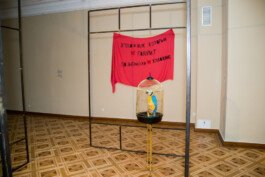
Alexander Brener's action "Why Wasn't I Included in This Exhibition?" finds new life in Karabinovich's practice through a chain of associations that leads from Moscow Actionism through Marcel Broodthaers's conceptual investigations. The artist's reflection on his own inclusion in exhibitions — "When I began thinking about the work I wanted to show, the question that wouldn't leave me alone was: why was I actually included in this exhibition?"—inverts Brener's exclusionary anxiety into a puzzle about inclusion's arbitrary logic.
This inversion leads to a complex meditation involving controversial Broodthaers's 1974 installation "Don't Say I Didn't Say So - The Parrot" at Antwerp's Wide White Space gallery. Broodthaers's piece created a visual image of the retrospective as exhibition concept, positioning a gray African parrot between tropical palms alongside a catalog from his 1966 exhibition "Mussels, Eggs, French Fries, Pot, Coal" and its reprint with "parrot" added to the title, all accompanied by a recording of the artist reading his poem "I say, I say."
In his installation, Karabinovych deliberately replaced Broodthaers’s live parrot with a colorful toy bird that calls out in his voice: "Why was I included in this exhibition?, refusing to subject a living bird to the ordeal of exhibition. The swap of toy for living creature questions what is real and what is representation, yet preserves the critique of institutional logic.
Like Broodthaers's parrot repeating words without understanding their meaning, Karabinovich positions himself as a participant in processes whose logic remains opaque. Yet this positioning is itself strategic, creating space for critique while acknowledging the impossibility of complete understanding or control over the mechanisms of artistic legitimation.
The expansion of Karabinovych’s references carries particular weight. By turning to Balkan artistic practices rather than relying only on Western models, his work opens space for connections and exchanges outside the usual centers of cultural power. Within Ukrainian contemporary art, this gesture is especially significant: it shows that its position in the global field can be shaped through dialogue with neighboring ‘peripheries’ as well as with dominant centers. The series functions both as an artwork and as a curatorial proposal, sketching new maps of influence and contact. At a time when questions of cultural dominance and language are increasingly urgent, Karabinovych points toward alternative forms of exchange that move beyond established hierarchies of prestige.
Through its combination of self-reflexive humor, generous homage, and institutional critique, "While I Am Young, I Make Bad Works" emerges as a significant contribution to ongoing conversations about artistic legitimacy, cultural translation, and the possibilities for peripheral artistic practices within global contexts. The work's particular genius lies in its ability to transform conditions of marginality into sources of creative possibility, suggesting that perhaps the most important artistic works emerge not from centers of power but from the creative tensions generated at their edges.
Exhibitions
2023 CEREMONIAL, gallery Art Walk, Warsaw, Poland
2020 WHOmanity, Amsterdam ferry festival, Amsterdam, Netherlands
2017 Muhi 2017 – Young Ukrainian artists, National Shevchenko Museum, Kiyv, Ukraine
2016 Frierfest, Tea Factory, Odesa, Ukraine
Related
Press