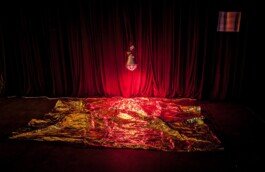
Odesa Biennale
Information
In collaboration with Mikhail Rashkovetsky
Semen Kantor (Commissar)
Contributing artists:
Seckin Aydin (Turkey), Max Afanasyev (Ukraine), Duygu Nazlı Akova (Turkey), Silvia Amancei and Bogdan Armanu (Romania), Zanny Begg and Elise McLeod (Australia), Sergey Belik (Ukraine), Yevgenia Belorusets (Ukraine), Svitlana Biedarieva (Ukraine–Great Britain), Irina Berezhko (Ukraine–Netherlands), Martinka Bobrikova and Oscar de Carmen (Slovakia–Spain–Norway), Bondero (Ukraine–Netherlands), Eugen Brytavsky (Ukraine), Oksana Bryukhovetska (Ukraine).
Yvon Chabrowski (Germany), Gennadiy Chernega (Ukraine), David Chichkan (Ukraine), Gigi Cifali (Italy), Oleg Dimov (Ukraine), Dmitry Erlikh (Ukraine), Zoya Falkova (Kazakhstan), Daniil Galkin (Ukraine), Ghost of a Dream (USA), GORSAD (Ukraine), Sergiy Grigorian (Ukraine), Roman Gromov (Ukraine), Sophie Guyot (Switzerland).
Oleg Kharch (Ukraine), Rudolf Herz (Germany), Juliana Heschlová (Czech Republic), Uladzimir Hramovich (Belarus), Ivaylo Hristov (Bulgaria), Martin Hüttel (Germany), Jere Ikongio (Nigeria), Nikita Kadan and Yuri Leiderman (Ukraine), Alevtina Kakhidze (Ukraine), Nikolay Karabinovych (Ukraine), Vasilis Karvounis (Greece), Mehrdad Khataei (Iran), Irina Kostyshina (Ukraine), Vladimir Kozhukhar (Ukraine), Vadim Kruglikov (Israel), Daria Kuzmych (Ukraine).
Alican Leblebici (Turkey), Llobet / Pons (Jasmina Llobet and Luis Fernández Pons) (Spain), Nikolay Lukin (Ukraine), Mikhail Markin (Ukraine), Dawid Marszewski (Poland), Mario Matoković (Croatia), Vladimir Miladinović (Serbia), Bojan Mrđenović (Croatia).
Tatyana Ostapenko (USA), Marie Ouazzani and Nicolas Carrier (France), Fransuaza Oz and Bogdan Perevertun (Ukraine), Kristina Paustian (Germany), Dan Perjovschi (Romania), Emilia Persenico (Italy), Christopher Pugmire (France), Dani Ploeger (Great Britain), Peter Puype (Belgium), Valeriy Puzyk (Ukraine).
Kateryna Radchenko (Ukraine), Oleksiy Radynskyi (Ukraine), Beatriz Vianna Reis (Brazil), Herbert Rometsch and Krolikowski Art (Germany–Ukraine), Mark Salvatus (Philippines), Sergiy Savchenko (Ukraine), Mykyta Shalennyi (Ukraine), Aleksander Shevchuk (Ukraine), Shivkumar K V (India), Natalia Shulte (Ukraine), Lena Siyatovskaya (Ukraine), Olia Sosnovskaya (Belarus), Alnis Stakle (Latvia).
Waldemar Tatarchuk (Poland), Meliha Teparić (Bosnia and Herzegovina), Christopher Thompson (USA), Ivana Tkalčić (Croatia), Aleksei Tovpyga (Ukraine), Yael Toren (Israel), Nicolas Vionnet (Switzerland), Stas Volazlovsky (Ukraine), Albina Yaloza (Ukraine), Vladimir Yershykhin (Ukraine), ZOI Group (Inna Prodan, Nadia Smirnova) (Ukraine).
Special projects.
Poland. The project of the Adam Mickiewicz Institute. Curator: Monika Szewczyk. Artists: Hubert Czerepok, Katarzyna Pazura, Jadwiga Sawicka, Artur Żmijewski.
Ukraine. “Song of the Petrel. Short Course” project of the Kharkiv Municipal Gallery. Curator: Tatyana Tumasyan. Artists: Vagrich Bakhchanyan, Sergey Bratkov, Vitaliy Kohan, Boris Mikhailov, Yevgeny Pavlov, Anton Tkachenko, Hamlet Zinkovsky.
Italy–USA. “Delivering Obsolescence. Art Bank, Data Bank, Food Bank” project. Curator: Camilla Boemio. Artists: David Goldenberg (Great Britain), Fabio Lattanzi Antinori (Italy).
Ukraine. “The Raft Crimea. Trumps of Doom” project at Invogue Art Gallery, Odesa. Curators: Katya Taylor (Invogue Art), Lesia Kulchinska. Artist: Maria Kulikovskaya.
Ukraine. “Odyssey: Donbas — Kyiv, Donbas — Odesa” project by Odos group (Kyiv–Odesa). Authors: Darya Tsymbalyuk, Julia Filipieva, Victor Zasypkin, in collaboration with displaced families.
Ukraine. IZOLYATSIA. Platform for Cultural Initiatives (House of Culture). Curators: Lina Romanukha, Dima Sergeev. Artists: Marina Black, Marco Citron, Flavia Junqueira, Zhanna Kadyrova, Andrei Loginov, Georgy Marchenko, Luisa Nobrega, Dima Sergeev.
Ukraine. “Countryside Practices: Seasonal Closeness”, Odesa. Curator: Alexandra Tryanova. Artists: Petr Vladimirov, Alexandra Kadzevich and Maria Silchenko, Oksana Kazmina, Nikolay Karabinovych, Alena Mamay, Tanya Nepomyashcha, Mia D. Suppiej, Stanislav Turina.
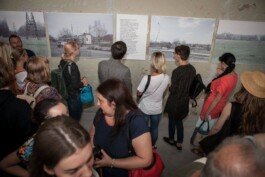
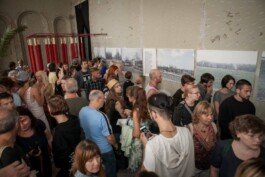
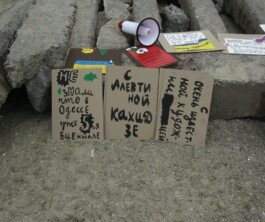
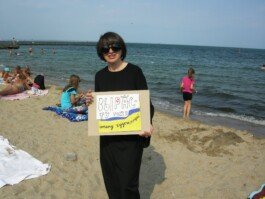
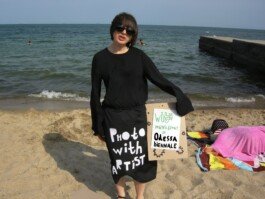
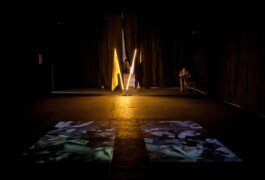
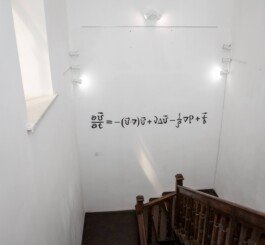
TURBULENCE AREA
Half a century later after “Future Shock” by Alvin Toffler outstanding sales manages discovered that we turned out in turbulent flow of V.U.C.A., volatility, uncertainty, complexity and ambiguity.
Easy to see that the times of turbulence are periodic phases in the state of human culture.
And they occur as a result of the culture activity itself. So the eidos of certainty and perfection in the Renaissance are replaced by turbulent eddies of Baroque.
But if earlier turbulence in the culture has been defined as crises or transitions with their spatial-temporal boundaries, now the state of turbulence claims to be the boundlessness. Ancient curse “May you live in era of change” is losing its meaning because contemporary culture does not assume any eras of stability. Output from turbulent area is considered as a catastrophe that ends human existence as a whole.
Unity and opposition to the private and the general come into the most danger zone of risk. Radical means of design modeling are urgently needed in a permanent change accelerates exponentially. One of such means has been art. A daily challenge of the art at all times has been work with universal relationship including dynamic one. Value of this function in turbulent zone seeks to infinity.
We once again call to look into the essence of social problems through the specific and universal art optics.
We exist at the turn where isolation of audience of contemporary art (which is a generation of post industrial society) becomes unbearable.
Odessa Biennale once again confronts the artists the global problem. That, according to many authoritative experts, is one of the signs of provincialism or marginality. However, in the era of fundamental crises, and even more so – a crisis of fundamentality – true outline of the future often encountered in the margins of canonic texts, at the boundaries which are melting in the fire of innovations.
Press